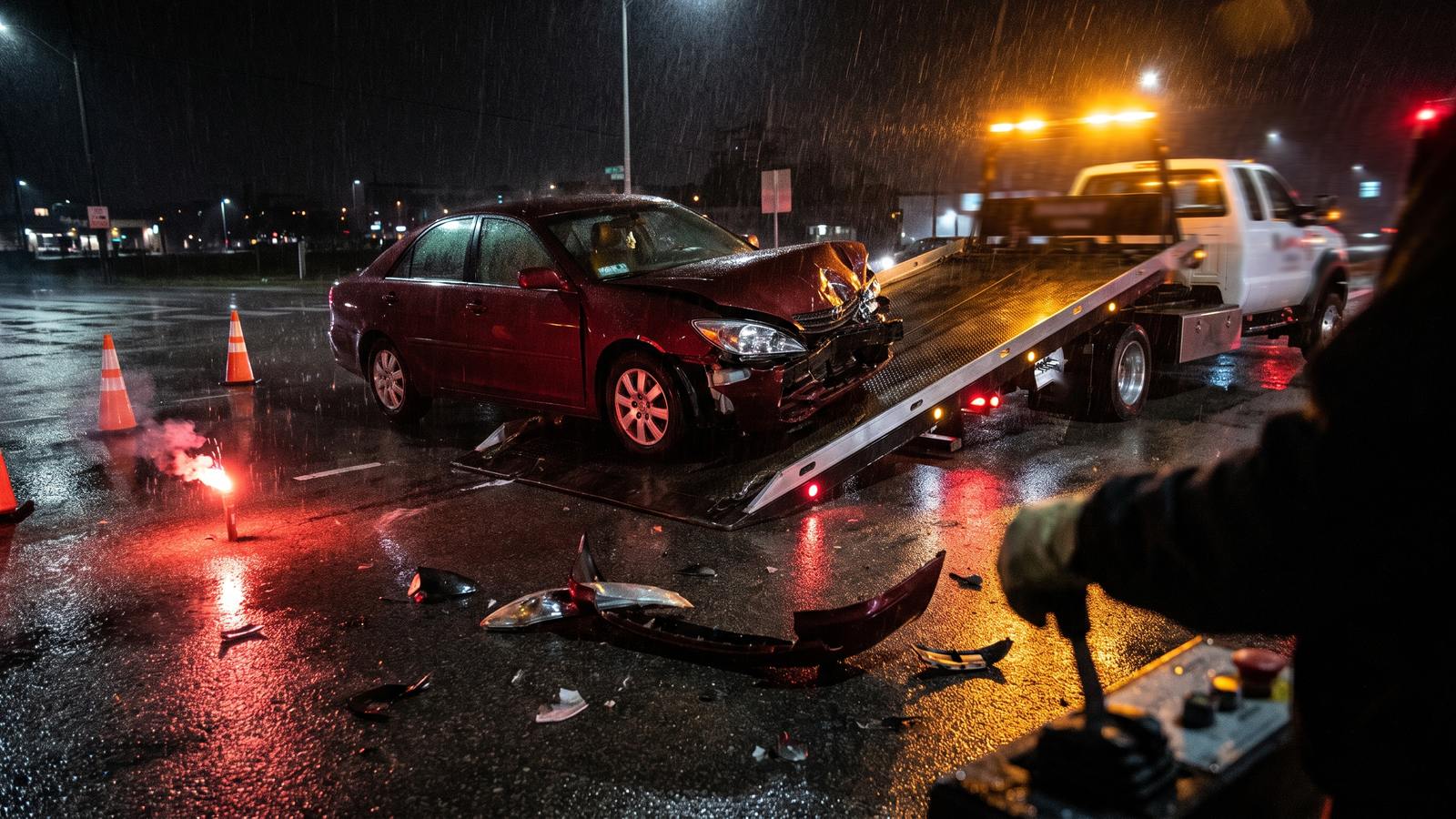
Collision towing in Portland, Maine
Accident towing to the body shop, dealer or home you choose, with a flatbed when the car cannot roll.
What should you do first after a crash in Portland?
If anyone is injured, if a car is sitting somewhere dangerous, or if you see fire or smell fuel, 911 comes first; the Maine State Police list 911 for calls from a cell phone. Once everyone is safe, call us for the collision towing. The tow truck can wait a few minutes. People cannot.
Accident towing in Portland is simplest when the steps come in this order:
- Check on everyone. Injuries, fire, fuel or a car blocking a live lane mean 911 before anything else.
- Turn on the hazard lights. Leave them on until the car is loaded.
- Get out of traffic if you can. If no one is hurt and the car still moves, get it to the right shoulder or off the road. If it will not move, get everyone out on the side facing away from traffic and stand well clear of the road, behind a guardrail where there is one.
- Take photos and swap details once it is safe to stand there. The checklist is further down this page.
- Call us with the spot and the destination; we send the right tow truck.
On I-295 and the Maine Turnpike
Highways have their own rules. Maine law keeps parked cars out of the traffic lanes, the ramps, the bridges and the left shoulder of limited-access highways such as I-95 and I-295, Tukey's Bridge over Back Cove included; the one exception is a car so disabled that stopping cannot be avoided (29-A section 2068(1)). On the Turnpike, Rule 3-B says a disabled vehicle belongs on the right shoulder and its driver must arrange prompt removal. For more on the highway side, see breakdowns on the Maine Turnpike and I-295.
Maine's move-over law tells drivers passing a stopped emergency vehicle, or a wrecker with its lights on, to change to a lane that is not next to it when they can, or, if that is not possible or safe, to slow to a careful and prudent speed (29-A section 2054(9)). Since October 25, 2023, drivers owe the same care to a stopped vehicle that appears to be disabled or has flashing lights going (29-A section 2070(8)). Either violation carries a minimum fine of $275. Your hazards help, but assume some drivers will not see them.
Who chooses the tow company after an accident?
Often you do. If the Maine State Police handle the crash, you are at the scene and the car is not being impounded, the trooper asks whether you have a preferred wrecker service and uses it unless it is unavailable or would take an unreasonably long time (General Order E-60). If you name us, we get the call, as long as we can get there in reasonable time.
If you are not at the scene, the trooper may call any available wrecker. That policy is statewide. On the Turnpike, and whenever another agency is handling the crash, tell the officer which company you want and ask how the tow will be handled.
Inside Portland
Portland police keep a towing list of wreckers that respond to police tow requests (City Code Sec. 28-121). We do not impound cars, and the City does not use us as its tow contractor. A tow the Portland police order goes to a wrecker on that list, and the car goes to that company's lot, because Portland no longer runs an impound lot of its own. Officers who order a tow must report the storage location to the dispatcher (Sec. 28-102(a)).
When the police order the tow
Maine law lets police have a car removed at the registered owner's expense when it is interfering with snow removal or the normal movement of traffic, and when the driver or owner is arrested or the car is tied to a crime (29-A section 2069). In those removals, the State, the city and the officers are not liable for damage or for the towing and storage charges, so the owner pays them.
Portland's code allows a wrecker at a crash or emergency scene only when the police or someone involved called it (City Code Sec. 28-128). You can call us yourself. If a truck turns up that nobody called, ask who sent it before you hand over the keys.
Does Maine car insurance cover accident towing?
Yes, up to $500 per accident, when a law enforcement officer requested the tow. That is the rule in 29-A M.R.S. section 1605-B: a liability policy on a car registered or mainly garaged in Maine must pay reasonable towing and storage costs, to that limit, whenever the car is towed at an officer's request.
- Coverage
- Up to $500 per accident
- When it applies
- A law enforcement officer requested the tow
- Which policies
- Issued or renewed on or after July 1, 2024
- What it pays
- Reasonable towing and storage for that car
The Maine Bureau of Insurance says in Bulletin 473, dated April 17, 2024, that the coverage is mandatory and must be provided even if you buy no collision, comprehensive or towing coverage. Insurers had to add it to policies newly issued or renewed on or after July 1, 2024. A 2025 bill to repeal the section failed, and the statute is still in force.
It covers only your own car's charges, and it does not apply to a policy covering more than 4 vehicles, or to policies for garages, dealers, repair shops, service stations or public parking places. If you called the tow yourself and no officer requested it, this rule does not apply, though your own towing or roadside coverage might, so ask your insurer. The full text is on the Legislature's site: 29-A M.R.S. section 1605-B.
Where does the car go after a collision tow?
Wherever you choose: your own body shop, the dealer, a shop your insurer works with, or home. Tell us on the call and the car goes straight there.
Not sure yet? Call your insurer while you wait for the truck, and tell the driver if it points you to a particular shop. If the shop is closed, late at night or on a Sunday, say so on the call, and we settle the plan with you before the car leaves the scene.
A flatbed for wheel and suspension damage
A crash can leave a wheel bent, a tire flat, the steering off or the suspension broken. A wheel-lift tow truck picks up only one end, so the other end rolls on the road, and a damaged corner there would be dragged. For those cars we send a flatbed, which carries the whole car clear of the pavement. Electric cars and all-wheel-drive models whose makers call for a flatbed get one too; our page on flatbed towing explains why.
What can a wrecker charge for an accident tow in Portland?
For a tow made without the owner's consent, such as one ordered from a crash scene, Portland's tow operator ordinance (City Code Sec. 28-122) sets the ceiling for an accident tow at $175. Storage is capped at $50 for each day or any part of one, and none can be charged for the first 24 hours after the tow.
- Accident tow
- Up to $175
- Storage, from 24 hours after the tow
- Up to $50 a day
- Off-road, submerged or rolled over
- Up to $80 more
- Recovery longer than an hour
- $80 an hour after the first
- After-hours release
- Up to $40
Those are maximums, not set prices, and the chief of police, or someone the chief designates, can approve more in unusual circumstances. The ordinance's $40 after-hours release cap applies to overnight releases, 7:00 p.m. to 7:00 a.m., and to a release at any hour on a Sunday or an official City holiday. Portland's rules also require tow operators to post their current rates at the release lot, keep that lot inside the city or no more than 7 miles from City Hall, tow cars there rather than drive them, make no repairs without the owner's consent, and release a car within one hour of the owner's request (Sec. 28-123).
Getting the car back takes satisfactory evidence that you are entitled to it and your signature on a receipt (Sec. 28-103), and after a police-requested tow, any parking fines you owe and other City charges have to be cleared first (Sec. 28-127). For urgent items such as keys or medications in a police-towed car, you can apply in writing, and the police chief may arrange for you to get them before you pay (Sec. 28-129). Maine law adds that in these cases the tow or storage operator can hold the car until reasonable charges are paid, but not the registered owner's personal effects, such as medications, medical equipment, clothing, mail and child car seats (29-A section 1861).
We do not impound vehicles, and the City does not use us for its tows. When you call us, you agree to the price before the truck comes: we give you the total on the call. More on how we price a tow.
What should you photograph and keep after an accident?
Photograph the cars and the scene before anything is moved, if it is safe to stand there, and keep every receipt that follows.
- Every vehicle, from every side, with the plates readable.
- Close-ups of the damage, inside and out, including glass, wheels and any airbags that went off.
- The scene: lane markings, signs, skid marks, the weather and road surface, and where each car came to rest.
- The other driver's details: name, phone number, insurer, policy number, plate and vehicle. A photo of their insurance card saves writing it down.
- Witnesses: names and phone numbers, before they leave.
- The police: the officer's name and agency, and the report or incident number.
- The tow: the company's name, where the car was taken, and every tow and storage bill.
Before the car leaves, take out what you will need over the next few days: medications, a child's car seat, documents, the garage opener, and house keys if they share a ring with the car key. Leave the car key with the driver.
What to tell us on the call
The location (an address or corner, or the highway, the direction of travel and the nearest exit), the make, model and year, the damage and whether the car rolls, the destination, and whether police are on scene. With that, we can send the right tow truck and give you the total.
More Portland, Maine towing help
We are a towing company in Portland, Maine that comes when you call, at any hour, across the city and the towns below.
Flatbed & Long-Distance Towing
Carried clear of the road: damaged, electric and AWD cars.
Learn moreWinch-Out & Snowbank Recovery
A car that slid into a ditch or a snowbank, pulled back out.
Learn moreTurnpike & I-295 Breakdowns
The rules and the numbers to call for a highway stop.
Learn moreRoadside Assistance
Dead batteries, lockouts, flat tires and empty tanks, any hour.
Learn moreTowing Services
Breakdowns, no-starts and moves across Portland, day or night.
Learn moreTowing Cost
How a Portland tow is priced, and what moves the number.
Learn more
Frequently asked questions
Can I choose my own tow company after an accident in Maine?
Yes, when the Maine State Police handle the crash and you are at the scene. Their policy is to ask the owner or driver which wrecker service they prefer and to use it unless it is unavailable or would take an unreasonably long time. That does not apply when the car is being impounded, and if you are not there, the trooper may call any available wrecker.
Will my insurance pay for a tow after a car accident in Maine?
Up to $500 per accident, if a law enforcement officer requested the tow. Maine's 29-A M.R.S. section 1605-B requires that coverage on liability policies for cars registered or mainly garaged in Maine, for policies issued or renewed on or after July 1, 2024, even without collision or towing coverage. Policies covering more than 4 vehicles are excluded.
How much can a Portland tow company charge for an accident tow?
Up to $175 for an accident tow made without the owner's consent, under Portland's tow operator ordinance (City Code Sec. 28-122). Storage tops out at $50 for each day or part of one, from 24 hours after the tow. When you call us yourself, we give you the total on the call.
Do you tow cars for the police?
No. We are not the City's tow contractor and we do not impound vehicles. We tow when you call us, or when an officer calls us because you asked for us, and the car goes where you choose.
Can a tow truck just show up at an accident in Portland?
No. City Code Sec. 28-128 bars a wrecker from coming to a crash or emergency scene unless the police or someone involved called it. If a truck arrives that nobody called, ask who sent it.
Should I move my car after an accident?
Yes, if nobody is hurt and it still drives: get it out of traffic, onto the right shoulder when it is a highway. On I-95 and I-295, Maine law keeps parked cars off the travel lanes, ramps, bridges and left shoulder unless the car cannot go on. If someone is injured, or the car is stuck where traffic is moving, call 911 and stay clear of the road.
Been in a crash in Portland? Call for the tow
Once everyone is safe, give us the spot and the destination, and the right truck heads out.
- The location - an address, a corner, or the highway and exit
- The make, model and year, and what is damaged
- Where it should go - your body shop, the dealer or home
- Whether police are at the scene